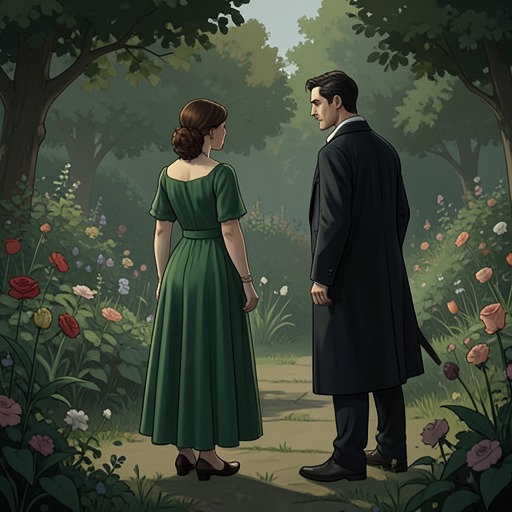
Elizabeth and Fitzwilliam Darcy’s wedding
Just DesertsElizabeth and Fitzwilliam Darcy’s wedding is the culmination of Elizabeth’s movement from constrained daughter and secretive survivor to a legally secure woman choosing marriage for love. The ceremony does more than formalize the couple’s affection: it follows Elizabeth’s earlier marriage to Sir David Pentland, answers the emotional and social dangers that shaped her life, and places her new union within the continuing moral and practical legacy of Sir David and Lady Radha Pentland.
Choice of Place and Form
The wedding is planned at St. Andrew’s Church rather than at Pemberley. Elizabeth argues that there is no reason to make everyone travel north, particularly at that time of year, and the choice carries personal meaning because her marriage to Sir David took place at the same church. She calls the connection appropriate to Sir David’s Scottish heritage, while Darcy accepts the location without objection and indicates that it is also his preference. The second ceremony therefore occupies a space already marked by Elizabeth’s widowhood, grief, and first experience of marital commitment. Elizabeth intends the ceremony to echo the earlier one while altering its emotional circumstances. She will again walk down the aisle on her uncle’s arm, and her sisters will attend, dressed through the generosity of Aunt Madeline, who plans to provide them with new Christmas dresses. The Gardiner family will be present, and Darcy’s sister and the Colonel are among the guests considered from his side. Servants and tenants from Grenadine Reef will not be formally invited in the manner of private family guests, but they will be welcome to attend. This distinction preserves the ceremony’s social form while acknowledging the estate community whose approval has repeatedly mattered to Elizabeth.
Family Reunion Before the Ceremony
The approach to the wedding includes a long-delayed reunion between Elizabeth and her sisters. When Jane Bennet sees Elizabeth after 50 weeks, she runs across the room and embraces her so fiercely that Elizabeth’s feet leave the ground. Mary Bennet and Catherine Bennet then join the embrace, with the same overwhelming happiness but more care for Elizabeth’s ribs. Their overlapping conversation registers not merely excitement about a wedding but the force of a sisterhood interrupted by secrecy, separation, and the consequences of Elizabeth’s hidden life. Elizabeth plans to confess her history and explain the approaching marriage before the ceremony. The sisters are astonished when Fitzwilliam Darcy is announced alongside the Gardiners, since they had not expected to find him there. Jane’s eventual response places the marriage within the family’s renewed understanding of Elizabeth. She recognizes that Elizabeth rescued the family after Lydia Bennet’s near-ruin, concealed and managed the consequences of Lydia’s stupidity, and has worked toward dowries of £25,000 for Jane, Mary, and Catherine. Jane interprets Elizabeth’s manner toward Darcy as evidence that the match satisfies the principle Elizabeth has always defended: she is marrying “for the deepest love.”
The Shadow of the First Marriage
Elizabeth’s explanation of her first wedding makes the contrast with the Darcy ceremony explicit. Sir David and Elizabeth were married at St. Andrew’s on a Friday morning, but Sir David was already so ill that he had to be carried to the church. He bore the physical ordeal stoically, slipped into unconsciousness that evening, and died early on Sunday morning. Elizabeth became a widow almost immediately after becoming a bride, and the memory gives the repeated setting a double charge: St. Andrew’s represents both the tenderness of a life-saving marriage and the abruptness of its loss. Sir David’s illness had also made the first marriage an act of urgent protection. He had told Elizabeth that he was dying of cancer, with a growing lump in his stomach, a constant ache, occasional spikes of pain, and diluted laudanum taken at night to help him sleep. He believed that Elizabeth’s achievement of majority and escape from Mrs. Bennet required immediate assistance, and he proposed a marriage of convenience whose financial arrangements could secure her. Because his cancer advanced from an expected survival of perhaps a year to months and then weeks, the will and marriage settlement had to be prepared with extraordinary speed. The eventual marriage to Darcy takes place after that crisis, but it cannot be understood without the protection Sir David created for Elizabeth.
Ceremony and Public Meaning
The wedding itself is described as short, sweet, and filled with loving looks between Elizabeth and Darcy at the front of the church. Jane and Richard Fitzwilliam accompany them to the registry and sign the register as witnesses. Immediate family, invited guests, and the few people formally included occupy the first two pews, while the church is almost full with servants and tenants from the estate. The arrangement makes the marriage both intimate and public: its legal witness is concentrated among family and trusted companions, but its broader social witness comes from the people whose lives are connected to Grenadine Reef. The congregation’s presence also affirms Elizabeth as the future mistress of the estate. Her wedding is not presented as a private escape from the Bennets alone; it is a public succession of care and responsibility. The future is secure, Mrs. Darcy is radiantly happy, and the legacy of Sir David and Lady Radha is explicitly to be honored and maintained. The wedding thus joins romantic fulfillment to estate governance, charitable obligation, and the continuity of a household shaped by rescue and refuge.
Aftermath and Continuing Legacy
The wedding breakfast is again more a tenant celebration than the season’s grand social event. It is described as a Boxing Day party held two weeks late, preserving the community-centered character associated with Elizabeth’s life at Grenadine Reef and with Sir David’s public standing there. The Darcys do not remain long because they want to reach London and Darcy House without delay; they promise to return in a week, leaving the household to finish answering the questions that their new status has generated. Elizabeth’s marriage to Darcy also coincides with a larger settlement of family and estate obligations. Darcy is delighted by her plan for Longbourn, through which responsibility for providing dowries returns to her father rather than remaining upon her. Elizabeth intends Jane, Mary, and Catherine to receive substantial dowries, while the expansion of Grenadine Reef by 2,000 acres and improved stewardship are expected to increase Longbourn’s income. The wedding therefore opens not into withdrawal from responsibility but into a reorganized network of family provision, land management, and female security. Its decisive significance lies in the way love, legal protection, public recognition, and inherited moral duty finally occupy the same structure.